
What Is Actionable Revenue Intelligence — And Why It's Not Analytics
Revenue intelligence isn't analytics. It's the difference between knowing what happened and knowing exactly what to do next. Here's why that matters for sports revenue teams.
Everyone says their platform delivers insights. Almost none of them do.
Most tools stop at showing you what happened. They’ll tell you ticket sales are down 8% quarter-over-quarter, or that three sponsors didn’t renew. They’ll show you a dashboard with color-coded metrics and trend lines. Then they’ll leave you to figure out what that means and what to do about it.
That’s reporting. It’s useful. It’s necessary. But it’s not intelligence.
The gap between those two things is where revenue gets lost — not because teams lack data, but because they lack the last mile between insight and action. For sports teams, entertainment venues, and live event businesses, that gap is especially expensive. Revenue windows close fast. A sponsor who’s quietly disengaging won’t wait for you to notice. A season ticket member at risk of churning won’t tell you they’re thinking about it. By the time a dashboard flags the problem, the window to act is often already closed.
Actionable revenue intelligence solves a different problem than analytics. It doesn’t just tell you what happened. It tells you what to do next, who needs to do it, and why it matters more than the other fifty things competing for attention.
This article breaks down what that actually means — and why the distinction matters more in live entertainment than almost anywhere else.
The Hierarchy: Data, Reporting, Analytics, Intelligence
Most organizations conflate these terms. They’re not the same thing.
Data is the raw material. It’s every ticket sold, every email opened, every sponsorship contract signed, every premium seat renewed or not renewed. It lives in your ticketing system, your CRM, your email platform, your partnership tracker, your point-of-sale system. It exists, but it doesn’t mean anything yet.
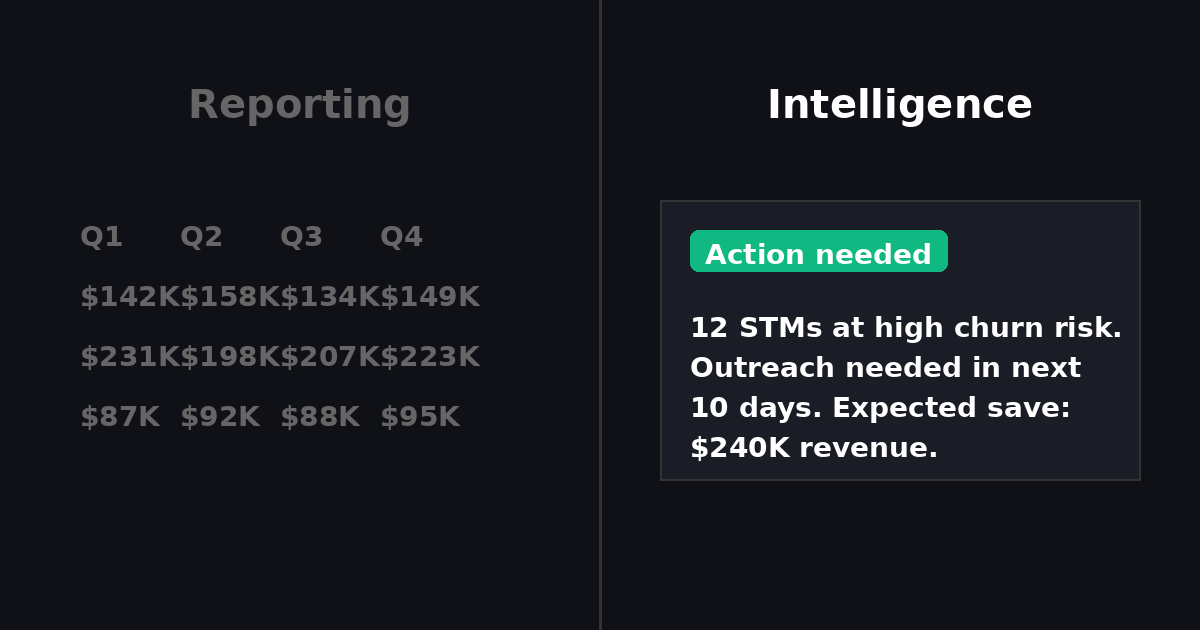
Reporting organizes that data into something readable. It aggregates, visualizes, and surfaces what happened. Revenue by channel. Attendance by game. Renewal rates by segment. Reporting answers “what” and “how much.” It’s backward-looking. It’s essential infrastructure, but it doesn’t tell you what to do.
Analytics goes a layer deeper. It applies statistical methods to identify patterns, trends, and correlations. Analytics might tell you that season ticket members who attend fewer than four games in their first season are 60% more likely to churn. It might show you that sponsorship engagement drops significantly in the 90 days before renewal. Analytics answers “why” — but it still doesn’t tell you what to do about it.
Intelligence is where the category changes. Intelligence takes those patterns and turns them into prioritized, actionable recommendations with clear owners and expected outcomes. It doesn’t just say “STM attendance is correlated with renewal risk.” It says: “12 season ticket members in the premium section have attended one or zero games this season and are up for renewal in 60 days. Expected churn risk: $240K. Recommended action: personal outreach from account manager with upgrade offer to a different seating section. Owner: Sarah in Premium Sales. Expected lift: 40% retention improvement.”
That’s the difference. One is information. The other is a decision, ready to execute.
The Five Components That Make an Insight Actionable
Not all insights are created equal. Most analytics platforms produce observations that require significant interpretation before anyone can act on them. Actionable revenue intelligence has a specific structure.
Signal. What changed, and why does it matter? This is the triggering event or pattern — a sponsor’s executive team turned over, a cohort of STMs stopped engaging with email, a partnership’s activation budget dropped 40% compared to last year. The signal is specific, timely, and measurable.
Context. Why does this signal matter right now, and how does it compare to the baseline? Context might include historical benchmarks, peer comparisons, or financial impact. A 15% drop in email engagement means nothing without knowing whether that’s normal for this time of year, or whether it’s a leading indicator of churn in this segment.
Recommendation. What specific action should be taken? Not “monitor this” or “keep an eye on engagement.” A real recommendation is precise: “Schedule a check-in call with the VP of Marketing at this sponsor within the next 10 days to discuss activation performance and surface early renewal options.”
Owner. Who is responsible for acting on this? Intelligence without ownership is just interesting information. The recommendation needs to land in the right person’s workflow — not buried in a weekly report that twelve people receive and no one owns.
Expected outcome. What happens if you act on this, and what happens if you don’t? This is the business case. If you intervene now, retention likelihood increases from 40% to 75%. If you wait 60 days, the window closes and churn is nearly certain. The expected outcome turns the recommendation from a suggestion into a prioritized decision.
Without all five components, you have analytics. With all five, you have actionable revenue intelligence.
Why Most BI Tools Stop at Step Two — And Why That’s the Expensive Part
Business intelligence platforms are built to surface data and generate reports. They’re good at aggregation, visualization, and historical analysis. But most of them stop there — and the reason is structural, not technical.
Traditional BI tools are built for analysts, not operators. They assume that someone will interpret the data, form a hypothesis, build a recommendation, assign it to the right person, and follow up on execution. That workflow works in environments where revenue cycles are long and windows to act are wide. It doesn’t work in live entertainment.
In sports and live events, the decision window is almost always shorter than the analysis cycle. By the time someone pulls a report, schedules a meeting to discuss it, assigns an owner, and puts together an action plan, the opportunity is often gone. The sponsor renewed with a competitor. The STM didn’t renew. The premium suite went unsold. The hospitality package got marked down.
The expensive part isn’t generating the insight. It’s the gap between the insight and the action. That’s where revenue leaks.
Most BI platforms can tell you that 18% of your season ticket members are at elevated churn risk. Actionable revenue intelligence tells you which twelve need outreach this week, what offer is most likely to retain them, and who on your team should make the call. The difference in execution speed is the difference between protecting the revenue and writing it off.
Three Real Examples from Sports and Entertainment
Sponsorship renewal risk. A professional sports team has 40 corporate partnerships up for renewal in the next 120 days. The CRM shows contact history. The activation tracker shows deliverables. The finance system shows contract value. None of those systems talk to each other, and none of them tell the partnerships team which renewals are actually at risk.
Actionable revenue intelligence pulls behavioral signals across all three systems. It identifies that five sponsors have had zero executive-level engagement in the past 90 days, two have reduced their activation spend by more than 30%, and one has a new CMO who wasn’t part of the original deal. It flags those seven partnerships — $2.1M in annual contract value — and generates specific recommendations: executive sponsor call for the five with low engagement, performance review and early renewal discussion for the two with reduced spend, relationship reset meeting for the one with leadership turnover. Each recommendation has an owner, a timeline, and an expected outcome.
The team acts in the first 30 days of the renewal window instead of the last 10. Retention rate on those at-risk deals goes from 40% to 78%. The difference is $800K in retained revenue that would have otherwise churned.
Season ticket member churn. A minor league baseball team has 1,200 season ticket members. Renewal season starts in 90 days. The ticketing system shows purchase history and attendance. The CRM shows email engagement. But no one is actively monitoring which members are trending toward churn until renewal notices go out — and by then, it’s too late to intervene.
Intelligence changes the timeline. It identifies that 75 STMs have attended fewer than 25% of games, stopped opening emails, and haven’t logged into their account portal in 60+ days. It segments them by tenure, ticket type, and original purchase channel, then generates differentiated retention plays: longtime members get a personal call from their account rep with a flexible payment plan offer. First-year members get a seating upgrade. Family plan holders get added kids’ club benefits.
The team executes outreach 75 days before renewal, not 10 days after non-renewal. Retention improves by 22 percentage points in the at-risk cohort. That’s $140K in saved revenue from a segment that was trending toward 100% churn.
Premium suite upgrade intent. An NBA team has 45 premium suites, with 80% occupied and 20% vacant or underutilized. The revenue team wants to fill the empty inventory and upsell current suite holders into longer or more expensive packages. But they don’t have a clear signal for who’s likely to buy or upgrade.
Intelligence surfaces intent. It identifies that three current suite holders have increased their food and beverage spend by 40%+ this season, two have brought different guests to every game (suggesting corporate use), and one has inquired about adding games to their partial plan. It also flags two companies that have purchased club seats for the past two seasons and have hired 50+ employees in the market in the last six months — a leading indicator of premium suite interest.
The sales team gets a prioritized list of eight prospects with specific talking points for each. Two current suite holders upgrade to full-season. One new logo converts from club to suite. Total incremental revenue: $320K. None of those deals would have been prioritized without the intelligence layer.
Why This Matters More in Live Entertainment Than Anywhere Else
Revenue intelligence as a category was built for B2B sales teams — companies like Gong, Clari, and Revenue.io built platforms to help sales reps close more deals by analyzing conversation data and engagement patterns. The principles are sound. But the application is narrow.
Live entertainment has the same problem — fragmented data, no clear signal on what to do next — but the stakes are higher. In SaaS sales, you lose a deal and you can come back next quarter. In sports and entertainment, the window is the season. If a sponsor doesn’t renew, you have 12 months before the next opportunity. If a season ticket member churns, you’re not getting them back mid-season. If a hospitality package doesn’t sell before the event, the revenue is gone.
The cost of acting too late is permanent. That makes the gap between analytics and intelligence more expensive in live entertainment than in almost any other category.
And yet, almost no one is building revenue intelligence specifically for this vertical. The tools that exist are either generic BI platforms that require a data team to extract insights, or sports-specific analytics platforms focused entirely on on-field performance — player stats, injury prediction, game strategy. No one is addressing the business side: ticketing, partnerships, hospitality, renewals, upsells.
That’s the gap Breadcrumb is built to close.
What the Best Revenue Teams Do Differently
The best revenue teams don’t treat intelligence as a reporting function. They treat it as an operating system.
They don’t wait for quarterly business reviews to surface at-risk renewals. They get alerts the moment a behavioral signal crosses a threshold — low engagement, reduced spend, leadership turnover, contract approaching renewal with no recent executive touch.
They don’t rely on their CRM to tell them what to do. They rely on intelligence to prioritize the thirty things competing for attention and tell them which three matter most this week.
They don’t treat dashboards as the end product. They treat recommendations as the starting point — and they route those recommendations directly into the workflows of the people who can act on them. The partnerships director sees at-risk sponsors in their pipeline. The premium sales manager sees upgrade-intent prospects in their task list. The ticketing lead sees churn-risk STMs flagged for outreach.
The workflow is continuous. The intelligence layer is always running. The window to act is always visible. And the gap between signal and action collapses from weeks to days.
That’s not a better dashboard. It’s a different operating model.
The Category Is New. The Problem Isn’t.
Revenue intelligence is still an emerging category, and most of the market conversation is dominated by SaaS sales platforms. But the underlying problem — too much data, not enough direction — is universal.
Sports teams have more data than ever. They know who bought tickets, who attended games, who opened emails, who engaged with content, who spent money on concessions, who renewed and who didn’t. But they don’t know what to do with it. They don’t know which signal matters most. They don’t know who should act on it. They don’t know whether to prioritize the at-risk sponsor or the upgrade-intent suite holder or the churn-risk STM.
Actionable revenue intelligence solves that problem. It closes the gap between knowing what happened and knowing exactly what to do next. It takes fragmented signals and turns them into prioritized recommendations with clear owners and expected outcomes. It removes the interpretation layer and puts the decision directly into the operator’s workflow.
That’s the difference between analytics and intelligence. One tells you what happened. The other tells you what to do about it — and gives you the tools to act before the window closes.
For revenue teams in sports and live entertainment, that difference is worth millions.
See how Breadcrumb delivers actionable revenue intelligence for sports teams, entertainment venues, and live event businesses. Book a discovery call to learn how we turn fragmented data into prioritized, executable recommendations.