
May 6, 2026 - By: Victor Tang
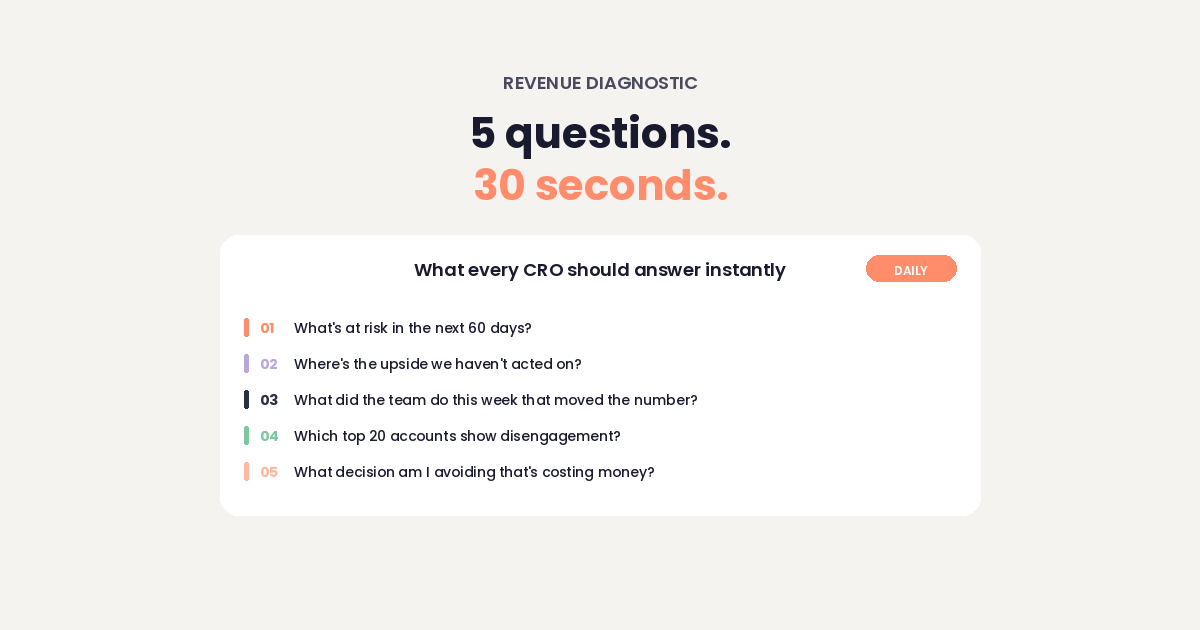
The 5 Questions Every CRO Should Be Able to Answer in 30 Seconds
The 5 CRO revenue diagnostic questions every Chief Revenue Officer should answer instantly. A sharper alternative to dashboards and quarterly reviews.
If your Chief Revenue Officer can’t answer five basic questions about the state of the revenue function in 30 seconds, you don’t have a leadership problem. You have a data problem — and probably a reporting problem on top of it.
This is one of those uncomfortable truths in modern revenue operations. Most CROs in sports, music, broadcasting, and live entertainment can produce a beautifully formatted quarterly review, complete with dashboards, charts, and segmented breakdowns. But ask them, off the cuff, what’s at risk in the next 60 days and what specifically they’re doing about it, and they’ll reach for a laptop. The information exists. The synthesis doesn’t.
The CRO revenue diagnostic questions below are the ones that matter. They aren’t designed to test your CRO’s intellect or composure — they’re designed to test whether the revenue function is actually instrumented for action, or whether it’s running on instinct dressed up as analytics. If the answers come fast and specific, the engine is healthy. If they don’t, you’ve found the gap.
Why Dashboards Make These Questions Harder, Not Easier
Before walking through the five questions, it’s worth saying why this matters. Most revenue teams have invested heavily in BI infrastructure over the last five years. Tableau. Power BI. Looker. Sisense. Custom warehouses, attribution models, sales analytics platforms.
And yet the most senior revenue person in the org still can’t answer fundamental questions on demand.
The reason is structural. Dashboards are built to display data. They’re not built to surface the answer. A CRO looking at a “revenue performance” dashboard is doing translation work in real time — scanning charts, mentally cross-referencing, interpreting movements, building the narrative on the fly. That’s why it takes 30 minutes, not 30 seconds. The dashboard isn’t the answer. It’s the raw material.
The five questions below cut through that. They aren’t about metrics. They’re about the specific, prioritized, account-level intelligence that should already be synthesized and ready before anyone asks. If your team is producing this kind of synthesis, your CRO answers in seconds. If they aren’t, you have a foundational gap masquerading as an operational one.
Question 1: What’s at Risk in the Next 60 Days, and What’s the Dollar Impact?
This is the leading-indicator question, and most CROs answer it badly because their team is still measuring lagging indicators.
A good answer sounds like: “We have $4.8M of renewal exposure in the next 60 days across 14 accounts. Three of those — totaling $2.1M — are showing the behavioral patterns that have historically preceded non-renewal. We’ve assigned interventions to all three. The other 11 are tracking normally.”
A bad answer sounds like: “Our renewal rate is tracking at 87%, slightly below last year’s pace. We’re working on it.”
The first answer demonstrates that risk is being monitored at the account level, in dollars, with specific intervention plans. The second answer demonstrates that risk is being monitored as a metric, after the fact, with no actionable response. Both come from the same data. Only one comes from the kind of intelligence layer a senior leader should have.
Question 2: Where’s the Upside in Existing Accounts We Haven’t Acted On?
Most revenue conversations focus on protecting the base. The most underutilized question is the inverse: what growth is hiding in your existing portfolio that nobody is systematically working?
Every sports team, broadcaster, music label, and venue I’ve worked with has at least 5–8% of incremental revenue available inside their current account base — premium upgrades, sponsorship expansions, suite-to-club conversions, partial-plan-to-full-season buyers. The signals are usually visible if anyone is looking: engagement patterns, transaction history, account-manager notes, behavioral inflection points.
A good CRO answer sounds like: “We’ve identified roughly $3.2M in expansion opportunity across 22 named accounts. The top six are being worked this month. The next ten are queued for outreach in the next quarter.”
A bad answer sounds like: “Our partnerships team is always looking for upsell.” Vague, retrospective, no quantification. Same data, no synthesis.
Question 3: What Did the Team Do This Week That Moved the Number?
This is the question that separates revenue leaders from revenue chroniclers. It’s not “what’s the number” — it’s “what’s the cause-and-effect relationship between team activity and revenue movement.”
Most CROs can tell you the number. Far fewer can attribute the movement. Even fewer can attribute it weekly. The team’s activity log usually exists somewhere — calls, meetings, contracts, save campaigns, pricing actions — but it’s almost never connected to revenue impact in a way that tells you what worked.
A good answer sounds like: “This week the team retained a $720K sponsorship that was at risk by accelerating an executive escalation. Three premium account upgrades closed totaling $185K. The single-game pricing adjustment we shipped Tuesday added an estimated $42K in pacing improvement. Net week: positive.”
This kind of answer is rare. It requires intelligence that connects activity to outcome. It also requires a CRO who has trained the team to think this way in the first place.
Question 4: Which of Our Top 20 Accounts Are Showing Disengagement Signals?
Disengagement is the most underweighted variable in revenue forecasting. Account managers track activity they did. They rarely track silence — when a top sponsor stops responding to check-ins, when a suite holder hasn’t attended in 60 days, when a key partner has gone dark on activation reporting.
The signals exist. They’re scattered across email systems, ticketing platforms, CRM logs, and engagement tools. The CRO who can answer this question quickly has a system that’s actively watching for the absence of activity, not just the presence of it.
A good answer sounds like: “Three of our top 20: [Sponsor X] hasn’t responded to the last two outreach attempts and engagement with their activation assets is down 40%; [Premium Account Y] hasn’t attended in three months despite available inventory; [Sponsor Z] is in good standing but their executive sponsor changed last month and we haven’t established the new relationship yet.”
A bad answer is silence, or a generic reassurance that “the partnerships team has good relationships.” Relationships aren’t relationships when they’re not being measured.
Question 5: What’s the One Decision You’re Avoiding That’s Costing Us Money?
This is the question most CROs hate, and the one ownership should ask most often. Every revenue function has at least one — usually several — decisions that the leader knows they should make and isn’t making yet. Pricing changes that have political risk. Personnel changes. Resource reallocations. Tool migrations. Pulling investment from underperforming channels.
The cost of these undecided decisions is real, and it usually compounds. A good CRO answer is honest and specific.
A good answer sounds like: “I’m avoiding a hard conversation with [Director X] about whether they’re the right person to run premium sales next year. The team is underperforming by 12% and I think it’s leadership-related. Cost of delay is probably another $400K in lost expansion this quarter.”
This is the question that reveals whether your CRO is leading the function or surviving it.
The Math: How 30-Second Answers Compound
These five questions seem deceptively simple. The reality is that producing fast, accurate answers to all five at any time requires an underlying intelligence layer — one that continuously monitors accounts, synthesizes signals, prioritizes risk and opportunity, and stays ahead of the next decision.
Organizations that have this kind of intelligence layer don’t just answer the questions faster. They make better decisions, and they make them earlier. Renewal risk is identified 60 to 90 days out instead of 10 days out. Expansion opportunities are surfaced systematically instead of accidentally. Activity is connected to outcome, which sharpens what the team prioritizes next week.
The compounding effect is real. The teams I’ve worked with that closed this gap saw measurable lifts in renewal retention (3–6 percentage points), expansion revenue (8–15% within existing accounts), and forecast accuracy (variance to plan reduced by half). Not because the teams worked harder, but because they saw earlier and decided faster.
Closing: The Questions Haven’t Changed. What’s Changed Is the Ability to Answer Them.
These CRO revenue diagnostic questions aren’t new. The best revenue leaders have been asking versions of them for decades. What’s new is the technology stack that makes it possible to answer them in 30 seconds instead of 30 minutes.
If your CRO is still pulling reports to answer these questions — or worse, deferring them to a follow-up email — the gap isn’t a leadership gap. It’s an intelligence gap. The good news is that the underlying data already exists in most organizations. The bad news is that nobody has connected it to the questions that actually matter.
That’s the work. And it’s increasingly the difference between revenue functions that compound and revenue functions that just keep up.
If your revenue org wants to answer these five questions in seconds — accurately, at any moment, with full account-level specificity — we should talk. Breadcrumb is built specifically for this. Learn more at breadcrumb.ai/contact.