
April 20, 2026 - By: Victor Tang
Why Premium Suite Revenue Is Harder to Protect Than Ever — And What the Best Teams Do Differently
Premium suite sales are up, but renewals are under pressure. Here's how the best sports revenue teams use intelligence to protect high-value accounts.
Premium suite sales are having a moment. Revenue is up. Waitlists are back. Some franchises are reporting record premium inventory growth.
And yet, ask any Director of Premium Sales what keeps them awake at night, and the answer is the same: the renewals feel harder to protect than they used to be.
The numbers tell the story. Individual suites can sell anywhere from $224,000 to more than $900,000 per year. Premium seats and suites represent less than 20% of total inventory but generate a disproportionate share of revenue. For most sports franchises, this is the revenue line the business actually runs on.
So when a seven-figure suite holder goes quiet, it’s not a ticketing problem. It’s a board-level problem.
This post is about why premium suite revenue has become harder to protect in 2026, why the traditional relationship-only renewal motion no longer scales, and what the best revenue teams are doing differently — namely, using revenue intelligence to see the signals before the conversation.
The Premium Market Is Growing. Protection Is Harder.
On the surface, premium sales look healthy. Across major leagues, premium inventory is selling faster and at higher price points than five years ago. New club seat sales are up meaningfully versus 2019. Corporate hospitality is still a proven lever for driving revenue and deepening sponsor relationships.
But the macro numbers obscure what’s actually happening account by account.
Three structural shifts have changed the renewal equation:
Corporate hesitation has increased. Tax code changes, heightened scrutiny on T&E spend, and ongoing expense rationalization at Fortune 1000 firms have made suite renewals a harder internal sell. Executives who used to sign off on a $450K suite without much debate are now being asked to justify it line by line.
Decision-making has fragmented. A decade ago, the suite decision sat with a single sponsor inside the client company. Now it often involves procurement, finance, marketing, and sometimes legal. The champion you’ve built a relationship with may not be the person who signs the renewal.
ROI expectations have sharpened. Premium isn’t just about luxury anymore. It’s about measurable business outcomes. Clients want to see utilization reports. They want to know how many deals closed in the suite. They want usage data that justifies the spend — and if your team can’t provide it, someone at the client’s finance team will ask pointed questions at renewal time.
None of these shifts are visible in top-line revenue numbers. They only show up in the quiet ways premium accounts start pulling back six months before they walk.
Why the Traditional Renewal Motion No Longer Scales
For decades, the premium renewal motion in sports has been built on one thing: relationships.
A Director of Premium Sales with two decades of experience knew their 80 suite accounts by memory. They knew which CEO loved baseball and which CMO hated it. They knew who brought clients and who brought their kids. They knew who would renew with a phone call and who needed a dinner.
That model worked when the renewal decision sat with one person, the relationship was stable, and the account list was manageable.
It breaks down under three conditions every premium team now faces:
The account list has grown. Modern venues have 60 to 150 suites, multiple tiers of premium inventory, 400+ club seats, and additional hospitality products on top. No single human — no matter how experienced — can track that much behavioral data in their head.
The decision makers have multiplied. When a renewal involves four people inside the client organization, the old “call the relationship” playbook isn’t enough. You need to understand how each stakeholder is engaging — or not engaging — with the product.
Turnover on both sides has accelerated. Premium sales leaders move teams. Client champions get promoted, reassigned, or laid off. Institutional memory disappears. The relationship-only model depends on continuity, and continuity is the first thing to go.
The best revenue teams have adapted. They haven’t abandoned relationships — relationships still matter enormously. But they’ve augmented the relationship with intelligence. They’re operating with data that tells them what’s happening across every account at once, flagging the ones that need attention before the relationship can catch it.
The Three Signals That Predict Suite Churn
When a premium account is starting to pull back, the signs are almost always there. They’re just spread across systems no one is watching together.
The three signals that most reliably predict suite non-renewal in the 90 to 180 days before the decision:
1. Utilization decline. The single most predictive signal. Not total utilization — that’s a lagging indicator — but the rate of change. A suite that went from 14 events used to 8 in a single season is showing a pattern. So is one where the guest list composition shifted from clients to internal employees, or from executives to junior staff. Utilization data lives in ticketing and access control systems, but revenue teams rarely connect it to renewal risk in real time.
2. Ancillary spend contraction. Food and beverage spend, parking, merchandise, and add-on purchases are leading indicators of how much the suite is actually being valued. When a client who used to order the premium F&B package starts cutting it back, or when parking passes go unused, something has changed inside the account. The spend decline usually precedes the renewal conversation by three to six months.
3. Stakeholder engagement fade. This is the softest signal but often the most important. Email open rates from the executive sponsor. Attendance at premium events outside of games. Responsiveness to the account manager’s outreach. Whether the client has introduced you to new stakeholders — or pulled them back. When engagement from the champion drops and no replacement champion emerges, the renewal is already in trouble.
The problem isn’t that these signals are hidden. It’s that they live in different systems — ticketing in one place, F&B in another, email engagement in a third, account notes in a fourth — and no one on the revenue team has time to correlate them manually across 100 accounts.
This is the gap revenue intelligence was built to close.
What the Best Premium Teams Do Differently
The premium teams protecting the most renewal revenue aren’t working harder. They’re seeing sooner.
Here’s what that looks like in practice.
Renewal risk is scored continuously, not quarterly. Every account has a live risk score that factors in utilization, spend, engagement, and stakeholder changes. When the score crosses a threshold, the system flags it to the account owner with a specific recommended action and a time window. No one has to remember to check.
Intelligence is delivered to the person, not the dashboard. Revenue leaders don’t want another dashboard. They want to know on Monday morning which three accounts need attention this week, why, and what to do. The best teams are moving from “pull reports” to “receive prioritized recommendations.”
Renewal conversations start before the client even thinks about it. When you see utilization declining at month four of a twelve-month cycle, you don’t wait for Q4 to have the renewal conversation. You call in month five, acknowledge the pattern, and solve the problem before it becomes a renewal objection. The best premium teams are running save motions six months before renewals are even on the calendar.
Save interventions are matched to the cause. A suite holder who’s declining because of budget pressure needs a different intervention than one who’s declining because their champion left the company. Intelligence platforms don’t just flag the risk — they identify the likely cause and recommend a matched response.
Portfolio-level visibility replaces gut feel. Instead of individual account managers tracking their own books, revenue leadership sees the portfolio. Which accounts are safe. Which are at risk. Which represent the biggest revenue exposure. Which interventions are working and which aren’t. Premium becomes a managed portfolio, not a collection of relationships.
A Real Scenario: $1.8M at Risk, 90 Days to Act
Here’s what this looks like in practice.
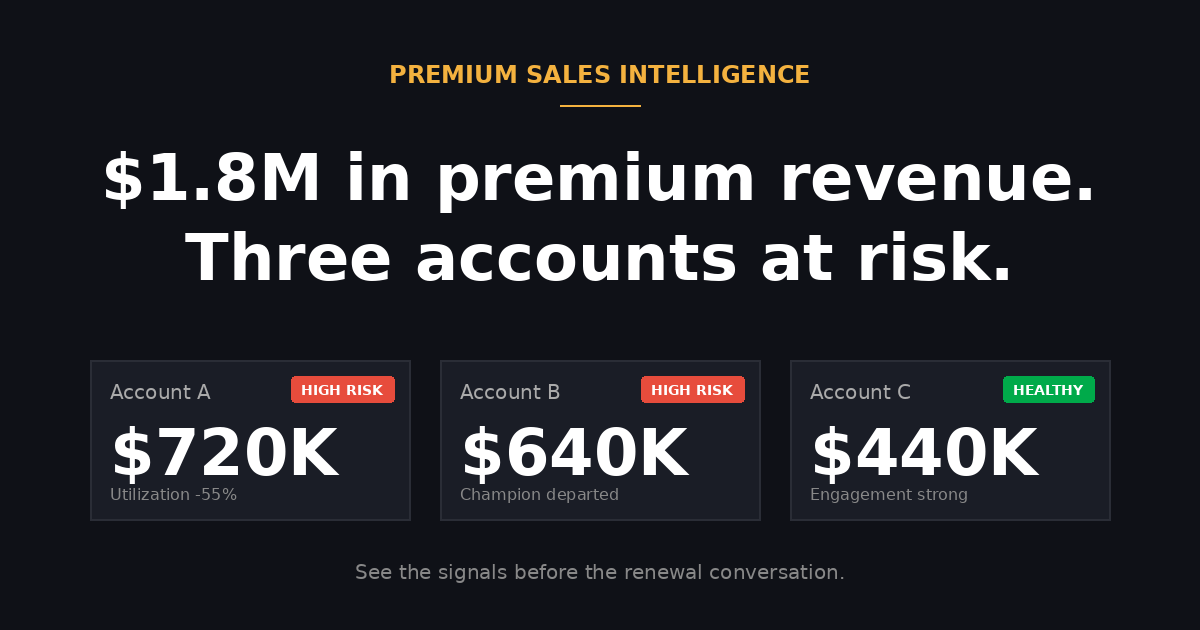
A franchise has three premium accounts representing $1.8M in combined annual suite revenue. All three renewals are due in 90 days. All three look fine in the CRM.
But the signals tell a different story.
Account A ($720K): Utilization down from 42 events last year to 19 this year. F&B spend down 55%. Executive sponsor hasn’t attended an event in four months. Account manager’s last three emails went unanswered.
Account B ($640K): Utilization stable. F&B spend stable. But the champion who signed the original deal left the client company two months ago. No new contact has been introduced. Email engagement has dropped to zero.
Account C ($440K): Utilization up slightly. F&B spend up. Engagement is strong. No red flags.
Without intelligence, all three accounts get the same standard renewal outreach in Q4. The account manager calls, sends the renewal paperwork, and hopes.
With intelligence, the approach is different for each:
- Account A gets an executive-to-executive outreach within 7 days, with a proposed utilization audit and a right-sized contract option if warranted.
- Account B gets an immediate stakeholder mapping exercise — who replaced the champion, who is the new economic buyer, and how to rebuild the relationship before the renewal window opens.
- Account C gets a standard renewal motion because it’s healthy.
Same portfolio. Same 90 days. Different outcomes.
The difference isn’t effort. It’s visibility. It’s the ability to see which accounts need what, and to act in time.
Premium Is No Longer About Luxury. It’s About Measurable Value.
The biggest shift in premium sales over the past five years isn’t the price points or the inventory. It’s what the client is buying.
A decade ago, a suite purchase was primarily a status and entertainment decision. Today, it’s a business decision that gets reviewed the same way every other significant vendor spend gets reviewed. The clients who renew are the ones who can justify the spend to their finance team with hard numbers — deals closed in the suite, customers entertained, retention lift from executive hospitality.
That means premium teams aren’t just selling an experience anymore. They’re selling an ROI case. And to do that credibly, they need the data to support it — which means better tracking, better reporting, and better intelligence about what’s actually driving value in the suite.
The teams that will dominate premium sales over the next decade are the ones that pair relationships with intelligence. Relationships still win the deal. But intelligence wins the renewal.
The Bottom Line
Premium suite revenue isn’t declining. But the work required to protect it has changed dramatically. The account lists are larger, the stakeholders are more complex, and the client’s internal case for renewal is harder to make than it used to be.
The revenue teams doing this best aren’t replacing relationships with software. They’re using intelligence to make their relationships work harder — to see signals earlier, to prioritize the right accounts, to start the renewal conversation before the client does.
The ones still operating on gut feel and Q4 phone calls will keep losing ground, account by account, year by year. The ones investing in intelligence will protect the revenue that matters most.
Want to see how Breadcrumb helps premium sales teams protect renewal revenue with real-time intelligence? Book a discovery call and we’ll walk you through what it looks like when every account in your premium portfolio has a live risk score and a recommended next action.