
April 15, 2026 - By: Victor Tang
How Sports Teams Are Using AI to Protect Renewal Revenue
Sports teams face billions in renewal risk hidden across fragmented systems. AI surfaces behavioral signals 60+ days before churn, turning renewal from a Q4 scramble into year-round intelligence.
The most expensive revenue leak in sports isn’t ticket pricing or sponsorship valuation. It’s the renewal window you didn’t see closing until it was too late.
A VP of Partnerships at an NBA team realized three sponsorship partners worth $4.2 million were at risk of non-renewal. The problem wasn’t the partners themselves. It was the timing. They had ten days to respond. The behavioral signals had been there for months, scattered across ticketing data, activation reports, and CRM notes. No one saw them until the decision was already made.
This is the renewal blind spot. Revenue leaders know renewals matter. They track contract dates. They run outreach campaigns. But by the time most teams realize a partner or season ticket member is reconsidering, the window to influence that decision has already closed.
AI doesn’t create new data. It surfaces the signals that were always there, earlier and with enough time to act.
Why Renewal Risk Is Hard to See Coming
Most sports organizations track renewal metrics at the account level: contract value, renewal date, last interaction. These are lagging indicators. They tell you what happened, not what’s about to happen.
The real signals exist in behavior, not contracts. A sponsorship partner who stops attending activation meetings. A season ticket member whose scan rate drops by 40% mid-season. A premium suite holder who used to bring clients every game but now comes alone. These patterns mean something. The challenge is that they exist in different systems.
Ticketing platforms track attendance and scan data. CRM systems log interactions and notes. Sponsorship activation lives in spreadsheets or email threads. Marketing automation captures engagement with campaigns. No single dashboard shows the full picture, so no one sees the pattern forming until it’s obvious, which means it’s too late.
This fragmentation is structural. Teams invest in best-in-class tools for each revenue stream, and those tools don’t talk to each other. The result is a data stack optimized for historical reporting, not forward-looking intelligence. You can run a dashboard showing last quarter’s renewal rate, but you can’t see which accounts are trending toward churn right now.
What Behavioral Data Tells You Before a Partner or STM Churns
The signals are consistent across both sponsorships and season ticket holders. Engagement doesn’t drop to zero overnight. It erodes gradually, in ways that are invisible in aggregate but clear when you look at individual account behavior over time.
For sponsorship partners, the early warning signs show up in activation participation. A brand that built an experiential activation in year one but declines to participate in year two. Meeting attendance that shifts from decision-makers to junior staff. Slower response times to partnership team outreach. Decreased use of allocated inventory, whether that’s suite access, hospitality, or branded content opportunities. None of these signals alone means non-renewal. Together, they form a pattern.
For season ticket members, the behavioral trajectory is different but equally predictable. Attendance frequency is the most obvious indicator, but it’s more nuanced than total games attended. A member who used to attend every game but now attends half might still renew if they’re transferring tickets to friends or family. A member who stops using tickets entirely and doesn’t transfer them is showing disengagement. Scan patterns matter too: late arrivals, early exits, and reduced concession spending all correlate with churn risk.
Secondary ticket market activity is another signal most teams miss. If a season ticket member is listing a higher percentage of their inventory on resale platforms, it suggests changing priorities. If they’re listing at below face value consistently, it suggests financial pressure or dissatisfaction with the product on the field.
The commonality across both sponsorships and STMs is this: behavioral change precedes renewal decisions by 60 to 90 days. The data exists. It’s just not connected, and most teams don’t have a mechanism to surface it as a prioritized action item for the right person at the right time.
The Cost of Acting Too Late
Timing changes everything in renewal conversations. A VP of Ticketing who identifies an at-risk season ticket member in September has options. They can offer a seat relocation, adjust pricing, create a custom payment plan, or invite the member to an exclusive event. The conversation is consultative, not transactional.
The same VP identifying the same risk in late November, two weeks before the renewal deadline, has fewer options. The conversation becomes defensive. The member has likely already made a mental decision. At that point, retention becomes a negotiation over price, and price concessions erode margin without addressing the underlying disengagement.
The math is straightforward. A 10% churn rate on a 5,000-seat season ticket base at an average of $3,000 per seat is $1.5 million in lost revenue. If early intervention reduces churn by even 20%, that’s $300,000 in protected revenue. The cost of acting late isn’t just the lost accounts. It’s the margin compression from last-minute retention offers and the operational cost of scrambling to backfill revenue.
For sponsorships, the stakes are higher and the windows are narrower. Partnership agreements often include 90-day notice periods for non-renewal. If a team identifies risk at day 85, there’s no meaningful intervention window. The sponsor has already had internal budget conversations. They’ve likely already allocated that spend elsewhere.
Early identification creates leverage. A partnerships director who sees engagement declining in month four of a twelve-month deal can course-correct activation, adjust deliverables, or create a mid-term value add. That same director at month eleven is managing damage control.
How AI Changes the Renewal Equation
AI-powered revenue intelligence does three things traditional dashboards can’t: it connects fragmented data across systems, identifies behavioral patterns at the individual account level, and surfaces risk as a prioritized recommendation with an owner and a timeline.
The technical mechanism is predictive modeling trained on historical renewal outcomes. The system learns which combinations of behavioral signals correlate with churn. It’s not tracking a single metric like attendance or engagement score. It’s identifying multi-variable patterns: decreased scan rate combined with increased secondary market listings combined with reduced response time to account rep outreach.
The output isn’t a score or a heatmap. It’s a specific action: “Partnership Director: ABC Beverage Co. showing 72% churn risk. Engagement down 40% vs. baseline. Recommend activation audit and executive touchpoint within 14 days.”
This shifts the paradigm from reactive monitoring to proactive intervention. Revenue leaders aren’t running reports to find problems. The system is telling them what needs attention, who should handle it, and when it needs to happen.
The lead time matters as much as the accuracy. A churn prediction model that’s 85% accurate with a 140-day lead time is more valuable than a 95% accurate model with a 30-day lead time. Accuracy gets you to the right accounts. Lead time gives you room to act.
A Real Scenario: Three Sponsorship Partners, $4.2M at Risk, 60 Days to Act
Here’s what actionable intelligence looks like in practice.
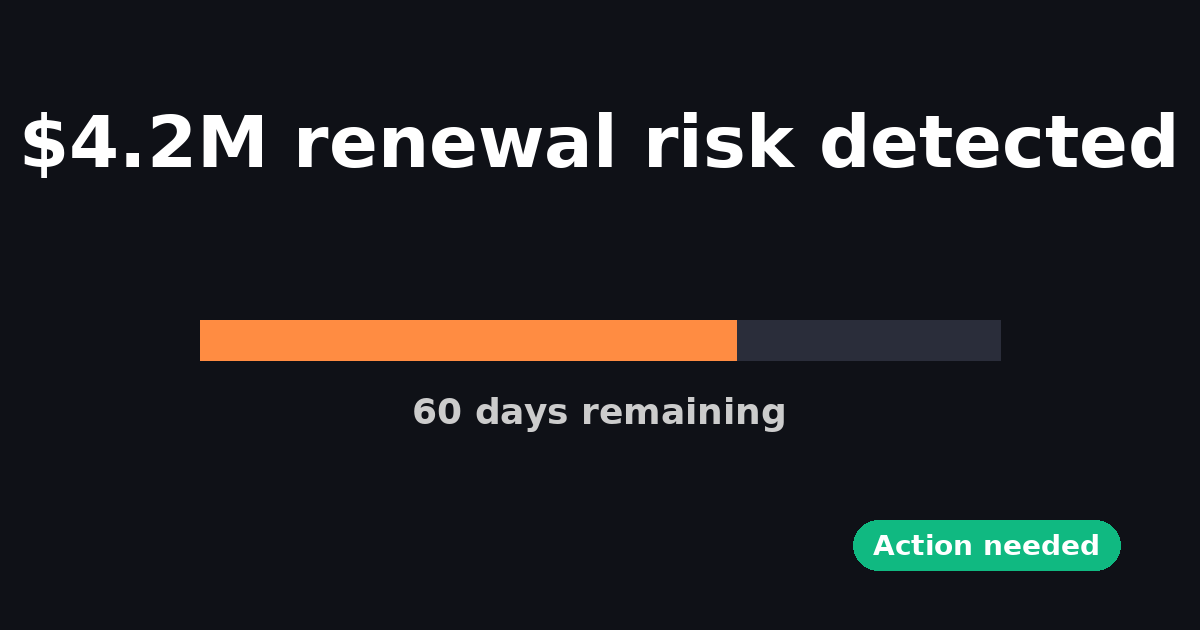
A Director of Partnerships at a professional soccer club receives a weekly intelligence brief. Three partnership accounts are flagged as high churn risk: a regional bank ($1.8M annual), an automotive brand ($1.5M annual), and a quick-service restaurant chain ($900K annual). Total exposure: $4.2 million. Time to renewal decision: 60 days.
The system doesn’t just flag risk. It explains the pattern. The bank’s primary contact, a VP of Marketing who championed the deal, left the company four months ago. The new stakeholder hasn’t attended a single activation meeting. Hospitality utilization is down 60%. The recommendation: executive outreach from the club president to the bank’s CMO, positioning the partnership as a board-level brand visibility play, not a marketing activation.
The automotive brand’s issue is different. Activation performance is strong, but the brand is consolidating sports sponsorships nationally and exiting three markets. The club isn’t one of them yet, but the brand has quietly reduced its experiential footprint at the stadium. The recommendation: build a case study showing market-specific ROI and present it to the brand’s national partnerships lead before the consolidation decision reaches this market.
The restaurant chain’s risk signal is utilization-based. They have a branded concourse activation space that generated strong foot traffic in year one. Year two traffic is down 35%, not because of location or execution, but because the chain launched a new menu that doesn’t align with stadium consumption patterns. The recommendation: propose a menu co-development pilot with the club’s F&B team, turning the activation into a product testing ground.
Three accounts, three different risk drivers, three different interventions. A dashboard would have shown three red flags. Actionable intelligence showed three specific plays. The partnerships team executed all three. Two renewals closed within 45 days. The third, the automotive brand, didn’t renew, but the relationship transitioned into a different asset tier, preserving $600K in annual value.
That’s the difference between seeing risk and acting on it.
What the Best Revenue Teams Do Differently
The highest-performing revenue organizations in sports don’t treat renewal as a Q4 event. They treat it as a year-round intelligence motion.
This starts with how they define renewal risk. Most teams define it by contract proximity: accounts within 90 days of renewal. The best teams define it by behavioral trajectory: accounts showing disengagement patterns regardless of contract timing. This shift in definition changes who gets attention and when.
They also separate reporting from intelligence. Reporting answers “what happened.” Intelligence answers “what should we do next.” Most BI tools are built for reporting. They show historical performance, aggregate metrics, and variance analysis. Revenue intelligence platforms are built for action. They prioritize accounts by risk and opportunity, assign ownership, and recommend next steps.
The operational difference is calendar structure. Traditional revenue teams run quarterly business reviews, monthly pipeline calls, and annual renewals campaigns. Intelligence-driven teams run weekly risk reviews, continuous engagement scoring, and intervention sprints. The cadence matches the speed at which behavior changes, not the speed at which contracts expire.
They also staff differently. The best teams have a dedicated role, often called a Revenue Operations Analyst or Intelligence Lead, whose job is to monitor signals, validate recommendations, and ensure interventions happen on time. This person isn’t running reports for leadership. They’re operating the intelligence system and holding account owners accountable to acting on what it surfaces.
The final differentiator is measurement. Most teams measure renewal rate as a trailing metric: percentage of accounts or revenue retained. Intelligence-driven teams measure intervention effectiveness: percentage of flagged accounts that received timely outreach, conversion rate of high-risk accounts that were engaged early versus late, and average lead time between risk identification and intervention.
Renewal rate tells you the outcome. Intervention metrics tell you whether your process works.
The Teams Protecting the Most Renewal Revenue Aren’t Working Harder — They’re Seeing Sooner
The renewal blind spot isn’t a data problem. It’s a timing problem. The signals exist. The challenge is surfacing them early enough to act and clear enough to prioritize.
AI doesn’t replace the relationships that drive renewals. It doesn’t close the deal for you. What it does is give you time. Time to have the right conversation with the right stakeholder before the decision is made. Time to course-correct activation before dissatisfaction becomes churn. Time to build the case for renewal before budget gets allocated elsewhere.
The teams winning on renewals aren’t working harder than their peers. They’re seeing sooner. They know which accounts need attention, why they need it, and who should handle it, with enough runway to make a difference.
The renewal window isn’t a deadline. It’s the end of a behavioral timeline that started months earlier. The question is whether you’re seeing that timeline in real time or reviewing it after the decision is final.
Ready to see renewal risk before the window closes? Book a discovery call with Breadcrumb and learn how we surface actionable intelligence for sports revenue teams.