
May 27, 2026 - By: Victor Tang
Why Most Sports Sponsorship Renewals Are Built on Guesswork
Sports teams struggle to prove sponsorship ROI because their data lives in silos. Here's what the smartest partnership teams do differently.
Why Most Sports Sponsorship Renewals Are Built on Guesswork
Imagine you’re the VP of Partnerships at a mid-market sports franchise. Renewal season is here. You have a meeting in three days with a title sponsor who wrote you a seven-figure check last year, and they want to know what they got for it.
You open your laptop and start building the deck.
Broadcast impressions come from one vendor report. Social reach lives in a spreadsheet someone pulled from Sprout. In-venue activation data is somewhere in an email chain with your experiential agency. Ticket redemption numbers — the ones that prove how many of that sponsor’s customers actually showed up — require a custom pull from your CRM that takes two days.
By the time you walk into that renewal meeting, you’ve spent 40 hours stitching together a story that is, at best, directionally accurate. You hope the sponsor doesn’t ask a question you can’t answer in the room.
This is how sports sponsorship ROI analytics actually work at most organizations. Not as a capability — as a scramble.
The Measurement Problem Nobody Talks About
The industry conversation about sports sponsorship ROI analytics almost always happens from the brand’s perspective. Shikenso, Zoomph, Relo Metrics — the category of sponsorship measurement tools has expanded rapidly, and nearly all of them are built for the sponsor trying to validate their investment.
That’s the wrong side of the table.
The harder problem — the one that actually determines whether seven-figure deals renew — lives inside the team. Your VP of Partnerships doesn’t need another vendor dashboard. They need a single view of what all their existing data says, assembled quickly enough to be useful before the renewal conversation, not after.
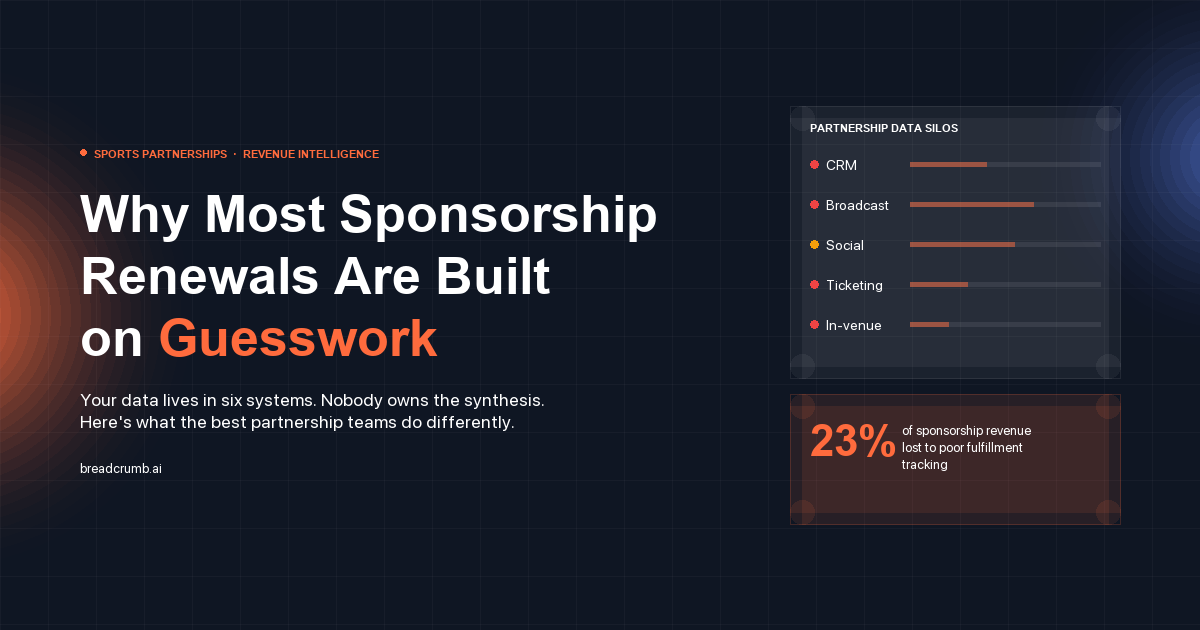
According to a 2025 industry study, 23% of sponsorship revenue is lost annually due to poor fulfillment tracking and missed renewal opportunities. For a team generating $2M in sponsorship revenue, that’s $460,000 left on the table every year — not because sponsors are dissatisfied, but because the team couldn’t clearly demonstrate the value it delivered.
The problem isn’t data. Every team has data. The problem is that no one owns the synthesis.
Where the Data Actually Lives (And Why It Stays There)
A typical mid-market sports franchise manages partnership data across at least six separate systems:
CRM holds contact history, contract terms, and notes from account managers. It rarely contains anything about actual asset performance.
Broadcast monitoring tools — third-party platforms like Relo Metrics or Nielsen — track logo exposure across linear TV, streaming, and social video. This data is expensive, arrives on its own cadence, and is formatted for the vendor’s output, not your reporting needs.
Social analytics platforms aggregate reach, impressions, and engagement metrics for branded content. Every platform exports differently. Aggregating them manually is a part-time job.
Ticketing and CRM data contains information about who bought tickets using sponsor-specific promo codes, or which fans attended sponsored experiences. This is the most valuable data in the building for proving sponsor ROI — and it’s almost never in the same place as the broadcast numbers.
In-venue and experiential data — foot traffic, activation scans, photo captures — often lives with the activation vendor, not with the team at all.
Email and event data tracks sponsor-presented communications: open rates, click-throughs, co-branded send performance.
None of these systems talk to each other. And in most organizations, the person responsible for renewal outcomes — the VP of Partnerships — has read-only access to most of them, if any access at all.
What Sports Sponsorship ROI Analytics Should Actually Look Like
The best partnership teams aren’t the ones with the most sophisticated tools. They’re the ones who have a consistent, fast way to answer three questions before every renewal conversation:
1. What did we deliver against what we promised?
Every sponsorship agreement has a media value estimate — impressions, activations, audience reach. The first job is comparing actuals to commitments. Most teams do this once a year, manually, before renewals. The teams that retain sponsors at a higher rate do it quarterly, proactively, so they can surface overperformance and correct underperformance before the contract anniversary.
2. What did the sponsor’s customers actually do?
This is the question that closes renewals, and it’s the one most teams can’t answer. If a bank sponsor runs a promo code promotion and 3,200 ticketholders redeem it, that’s a conversion story. If those redemptions skew toward 25–34-year-old households in the sponsor’s target geography, that’s an audience alignment story. If those fans also attended three or more events during the season, that’s a loyalty story.
The data for all three of those stories exists in the team’s own ticketing and CRM system. It’s almost never assembled and presented in a sponsorship context.
3. What’s the renewal risk, and who needs attention now?
Sponsorship renewals don’t fail at the renewal meeting. They fail six months earlier when a sponsor quietly stops seeing value and starts taking calls from competing properties. The teams that catch this early — through engagement signals, fulfillment gaps, or benchmark comparisons against similar-tier partnerships — have time to course-correct. The teams that find out in the meeting don’t.
The Operational Gap Between Data and Decision
Here’s what’s interesting about the sponsorship intelligence category: the measurement tools exist. Relo Metrics tracks broadcast exposure with computer vision. YouGov measures brand lift. CRM platforms capture every touchpoint. The infrastructure is there.
What’s missing is the layer between the data and the decision-maker.
Right now, that layer is a partnership coordinator with an Excel file and a tight deadline.
The VP of Partnerships shouldn’t need to request a custom report from three different departments to answer basic questions about their book of business. They should be able to ask those questions directly — in natural language, against the team’s own data — and get an answer in minutes.
“What was the total reach we delivered to Sponsor A this season, broken down by asset type?”
“Which of our mid-tier partners are underperforming against their contracted media value?”
“How many of Sponsor B’s promo code redeemers also attended premium events?”
These are not sophisticated analytics questions. They’re the questions that every renewal conversation requires. The reason they take days to answer isn’t a technology problem — it’s a data access problem.
What Smart Partnership Teams Are Building Now
The organizations getting this right have stopped waiting for a single integrated platform to solve the fragmentation problem. Instead, they’ve invested in a thin intelligence layer that connects what they already have.
The pattern looks like this:
Ticketing data, CRM data, and social analytics are brought into a single queryable environment — not necessarily a new database, but a unified view that a non-technical revenue leader can actually use. That environment gets an AI layer: not a chatbot, but a system that can translate questions about partnership performance into queries against those connected data sources, and translate the output back into a clear conclusion.
The output isn’t a dashboard. It’s a finding. “Sponsor A received 118% of contracted media value this season, driven primarily by broadcast logo exposure during home game broadcasts. Audience skew matches their stated target demographic (women 28–45). Recommend leading the renewal conversation with audience match data and proposing a broadcast-first package increase.”
That’s the difference between sports sponsorship ROI analytics as a reporting function and sports sponsorship ROI analytics as a revenue function.
The Renewal Meeting Changes When the Data Is Ready Ahead of Time
The teams that retain their major partners at the highest rates share one characteristic: they walk into renewal conversations already knowing the answer. They’ve done the analysis in advance, identified the value story, anticipated the objections, and built the proposal around what the data actually supports.
That posture is only possible when the VP of Partnerships isn’t personally responsible for pulling and assembling that data. When the intelligence layer does that work — continuously, not just before renewals — the relationship changes. The conversation moves from “here’s what we delivered” to “here’s what we should do next, and here’s why the data supports it.”
Sponsors renew when they believe the team understands their business. That belief doesn’t come from a slide deck. It comes from the quality of the analysis the team brings to the conversation.
The data to support that analysis already exists in your organization. The question is whether anyone can get to it fast enough to matter.
What This Means for Your Partnership Team
If your VP of Partnerships is spending the week before major renewals manually assembling reports from six different systems, that’s not a bandwidth issue — it’s a signal that your sponsorship revenue function is operating without the infrastructure it needs.
The floor-level fix is data consolidation: getting ticketing, CRM, broadcast, and social data into a single place that your partnership team can actually query. The higher-value move is adding an intelligence layer on top of that data — one that synthesizes what the team needs to know and surfaces it in time to act.
That’s what Breadcrumb is built for. Not dashboards your team has to interpret. A specific answer, for the right person, before the conversation that determines whether your biggest partners stay.
If your partnership renewal process still starts with a spreadsheet, it’s time to change that. Talk to us at Breadcrumb.